
Abat-Baytaq Necropolis, Memorial Museum Complex of Folk Architecture and Stone-Carving Art
Research History
According to Professor S. Äjığali, the earliest known reference to this mausoleum appears in the writings of the historian P. I. Rychkov, who noted that "in 1750, the engineer Rigelman, while traveling along the Kobda River, saw a mausoleum called 'Baytan,' which the local people regarded as their capital." One of the subsequent documentary sources is the work Nadgrobnye sooruzheniya kirgizskikh stepey (Funerary Structures of the Kyrgyz Steppes) by the archaeologist and orientalist J. A. Castagné, in which a photograph of the Abat-Baytaq Mausoleum was published for the first time.
In 1947, the engineer G. Gerasimov became the first researcher to carry out architectural measurements of the partially ruined mausoleum. Among Kazakhstani scholars, the first to organize an expedition to the Abat-Baytaq Mausoleum and publish information about it was the architectural historian M. Meñdīqūlov. In his work, he devoted considerable attention to the mausoleum's comparative and typological characteristics. His conclusions correspond closely with the descriptions of domed mausoleums presented by G. A. Pugachenkova, whose research provides extensive information on this architectural tradition.
In 2006, the mausoleum underwent a comprehensive scientific restoration as part of the State Program "Cultural Heritage." The collection Abat-Baytaq: The Pearl of the Kazakh Steppe was subsequently published, presenting numerous new materials concerning both the necropolis and the mausoleum.
The site is known as the Abat-Baytaq Necropolis, named after the monumental mausoleum situated at its center. For many years, the monument was believed to have been destroyed and effectively lost to scholarly research. It was only in the early 1980s that an expedition of the Ministry of Culture of the Republic of Kazakhstan, led by archaeologist Serik Äjığali, rediscovered the site. In 1982, the necropolis was included in the State Register of Historical and Cultural Monuments of Republican Significance and was subsequently placed under state protection.
Brief Description
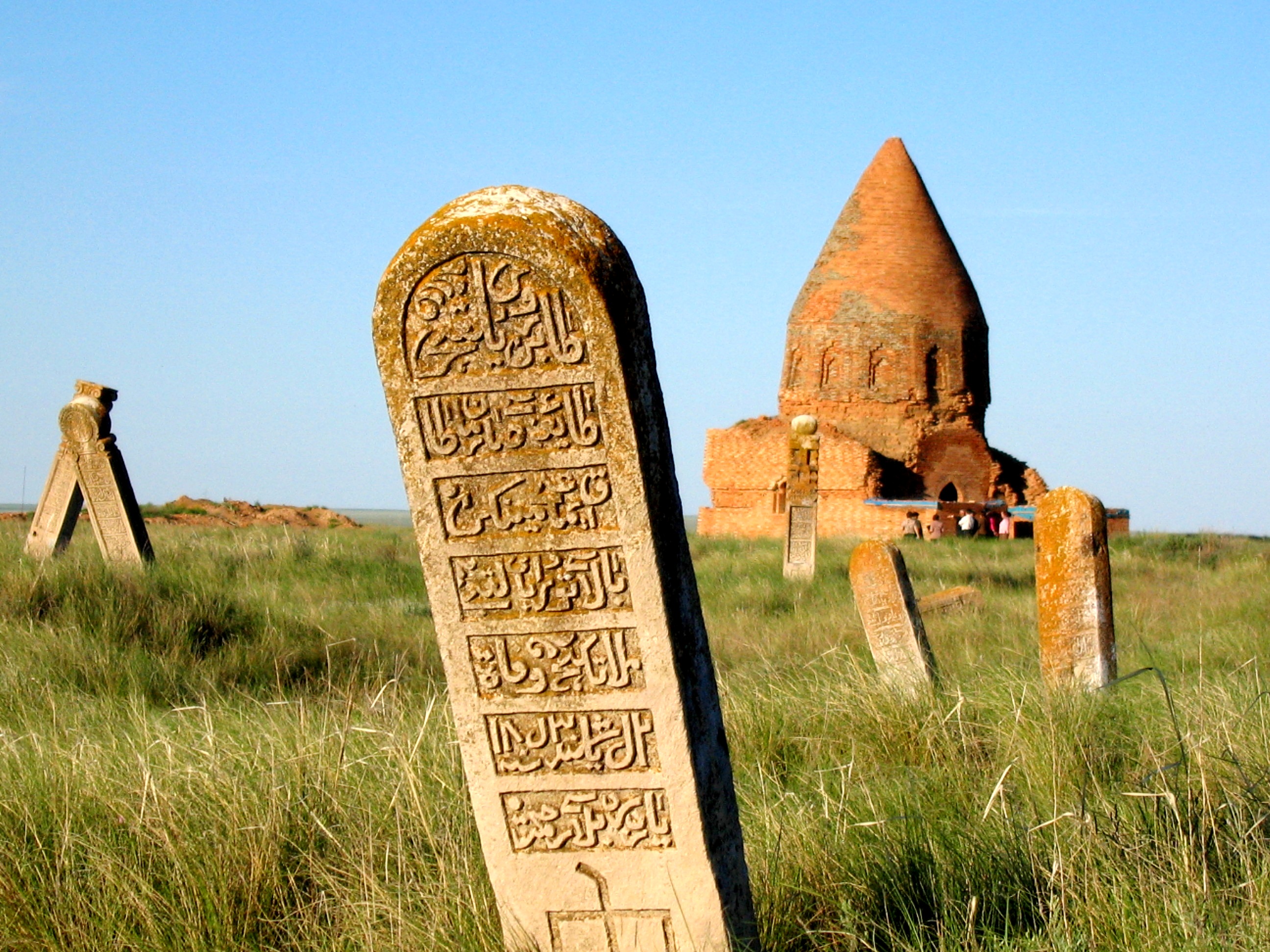
The Abat-Baytaq Necropolis is a historical and memorial complex distinguished by its remarkable architectural monuments. At the center of the necropolis stands the majestic Abat-Baytaq Mausoleum, whose restored dome once again dominates the surrounding landscape following extensive conservation and restoration work. A stone-paved pedestrian pathway leads visitors to the mausoleum.
According to the research of Professor S. Äjığali, the mausoleum originally featured walls approximately 3 metres thick and a façade rising to nearly 5 metres in height. Its original overall height was approximately 16 metres, while the preserved structure today stands at 14.5 metres.
According to the architectural historian M. Meñdīqūlov, the mausoleum's original height was 16 metres. However, measurements taken in 2004 by the renowned archaeologist Erbolat Smağūlov, who directed archaeological excavations of the burials within the mausoleum, indicate that its original height may have reached 17.2 metres. In the early 1980s, the architect and restoration specialist A. Itenov prepared the first conservation plan for the monument.
To the west of the mausoleum lies an extensive cemetery containing 243 carved tombstones dating from the 18th to the 20th centuries. These monuments display a rich variety of architectural compositions and decorative forms, representing some of the finest achievements of traditional Kazakh ornamental art and funerary craftsmanship. The epigraphic monuments preserve inscriptions in the Arabic script, together with engraved tribal tamgas (clan emblems), providing valuable evidence of the region's historical and cultural heritage.
Legend
When discussing the Abat-Baytaq Necropolis, researchers primarily focus on the imposing Abat-Baytaq Mausoleum at its center, examining its origin, those believed to have been buried there, its architecture and construction, archaeological investigations, the origin of its name, and other issues related to the monument. Several explanations have been proposed for the name "Abat-Baytaq."
The most widespread legend associates the mausoleum with Abat Batyr, the son of the legendary Kazakh philosopher and sage Asan Qaighy, who is remembered in folklore for traveling across the steppe on his zhelmaya (a swift riding camel) in search of Jerūyiq, the mythical land of peace, prosperity, and abundance, often described as a place "where even the skylark lays its eggs upon the back of a sheep." According to the legend, after Abat Batyr's death, the people erected the mausoleum over his grave in only three days. It is believed that the epithet "Baytaq" ("vast" or "boundless") was later added to his name to symbolize that the monument was built by the people of the vast Kazakh steppe.
Other interpretations concerning both the name of the mausoleum and the identity of the person buried there have also been proposed. One such version attributes the monument to Baytaq Batyr, a Kalmyk warrior. Professor S. Äjığali also refers to this tradition in his research. In an article published in 1896 in the newspaper Turgayskaya Gazeta, the researcher Ya. Polferov recorded a local tradition claiming that Baytaq Batyr, a commander under Batu Khan, was killed while fighting to liberate the Kobda region from the Kalmyks. According to the same legend, the warrior was buried together with his wife, his horse, and several Kalmyk captives. From a historical perspective, however, these legends contain significant internal contradictions and present differing interpretations of the monument's origin.
References
Nurlanuly, M. Old Residents. The Abat-Baytak Mausoleum. Qazaqstan Tarihy portal, 12 August 2015.
Ötemis, I. Abat-Baytaq: Ancient Tombstones Are Being Studied. Aqtöbe newspaper, 13 August 2019.
Quandyqqyzy, B. The Epigraphic Monuments of Abat-Baytaq. Egemen Qazaqstan, 14 February 2024.
Imambayeva, A. The Secrets of the Abat-Baytak Necropolis. MIR24, 20 September 2024.
Photo gallery
Location on the map
Related sites
 National significance
Daumshar Necropolis: Mausoleums, Saganatams, Qulpytases, and Small Architectural Forms
Baiganin district, 40 kilometres southwest of Zharkamys village
 National significance
Karasakal Necropolis: Mausoleum, Saganatam, Qulpytas, and Small Architectural Forms
Baiganin district, 60 kilometres southwest of Zharkamys village
 National significance
Asan Kozha Necropolis: Mausoleums, Saganatams, Qulpytases, and Small Architectural Forms
Baiganin district, 22.7 kilometres southwest of Miyaly village, and 43 kilometres southwest of Oimauyt village