
Khan Molasy Necropolis and Memorial Complex

History
Khan Molasy is a historic necropolis where Abulkhair Khan (1693–1748), one of the prominent statesmen and military commanders of the 18th century and ruler of the Kazakh Junior Zhuz, is buried. Located in the Aiteke Bi District of the Aktobe Region, between the Ulkeyek and Kabyrga rivers, this monument is closely associated with the political history of the Kazakh people, traditional burial practices, and the development of memorial architecture.
The formation of the necropolis dates back to the historical events of 1748. In August of that year, Abulkhair Khan was killed in a confrontation with Sultan Barak and was buried near the summer pastures along the Ulkeyek River. Information about the Khan's death and burial has been preserved in official documents of the 18th century, subsequent historical works, and oral traditions of the local population.
Abulkhair Khan played an important role in the political and military life of Kazakh society during the first half of the 18th century. He participated in organizing resistance against the Dzungar invasions and was elected commander-in-chief of the Kazakh forces at the assembly held in Ordabasy in 1726. The victories at the Battle of Bulanty-Bileuti in 1727 and the Battle of Anyrakai in 1730 are associated with his military leadership. In 1731, he made a historic decision that shaped the political relations between the Junior Zhuz and the Russian Empire. His life and activities were closely connected with the complex political developments taking place across the Kazakh Steppe.
Following Abulkhair Khan's burial, his grave became a place of special reverence among the local population. The Khan's relatives and descendants took steps to construct a mausoleum over his burial site. This issue was repeatedly raised in official correspondence with the Orenburg administration between 1749 and 1751. Nuraly Khan sought to establish a permanent memorial structure at his father's grave and requested building materials and skilled craftsmen for its construction.
Citing a shortage of construction materials in the burial area, the Orenburg administration proposed relocating the Khan's remains to another site near the Emba or Ural rivers. However, Nuraly Khan and his relatives rejected this proposal, insisting that Abulkhair's remains should stay at their original burial place. As a result, a mausoleum was constructed from adobe bricks in accordance with local building traditions. Historical documents from 1752 contain information about a report by Sultan Yeraly concerning construction work at the Khan's grave.
One of the most valuable descriptions of Abulkhair Khan's original mausoleum appears in the writings of N. Rychkov, who visited the area in 1771. According to his account, a rectangular structure built of adobe bricks stood above the Khan's grave. The entrance was located on the western side of the mausoleum, with the burial chamber inside and a large tree growing to the east. South of the structure was a designated area for memorial rituals and sacrificial offerings.
A description published by D. Eristov in 1835 provides information about the mausoleum's external appearance, its dome-shaped upper section, and a commemorative spear mounted on top. Pieces of cloth and other objects were tied to the spear. These accounts indicate that during the 18th and 19th centuries, the Khan's grave served not only as a burial site but also as a revered sacred place where pilgrimages and commemorative rituals were performed.
Over time, the mausoleum deteriorated under the influence of natural conditions and had lost its original appearance by the end of the 19th century. The principal landmark identifying the burial site was a solitary tree growing near the grave. Known among the local population as "Khannyn Taly," meaning "the Khan's Tree," it was mentioned in historical written sources and folk traditions. Its disappearance in the mid-20th century made identifying the exact location of Abulkhair Khan's grave considerably more difficult.
Scientific interest in the Khan Molasy necropolis intensified during the second half of the 20th century. In the 1970s and 1980s, the site attracted the attention of A. Kekilbayev, U. Zhanibekov, A. Satayev, and other public figures and researchers. Beginning in 1983, systematic scientific investigations of the necropolis were undertaken under the direction of historian and ethnographer S. Azhigali.
During the 1998 expedition, a preliminary topographic plan of the cemetery was prepared, and the remains of several burial structures were examined as possible matches for historical descriptions of the mausoleum. At that stage, Structure No. 3, located in the northeastern part of the necropolis, was considered a possible burial place of Abulkhair Khan. However, the researchers did not regard this hypothesis as conclusively proven and emphasized the need for further comprehensive investigations.
In 2001, a major West Kazakhstan Archaeological and Ethnographic Expedition conducted extensive research at Khan Molasy. The work refined the topographic layout of the necropolis, documented burial monuments, and examined epigraphic inscriptions on gravestones and the remains of ancient structures. The findings made it possible to study the development of the cemetery, its architectural characteristics, and the question of locating Abulkhair Khan's grave in greater detail.
Between 2007 and 2010, researchers employed methods from archaeology, anthropology, genetics, geophysics, historical cartography, and ethnography. Archival documents and recollections of local residents were compared with archaeological evidence collected directly at the site. As a result of these interdisciplinary investigations, Structure No. 92, situated in the northern part of the necropolis, was identified as the burial place of Abulkhair Khan.
The human remains discovered during the investigation of Structure No. 92 underwent anthropological and genetic analysis. The findings were compared with genetic data obtained from descendants of Abulkhair Khan and provided additional evidence supporting the researchers' conclusions. Hungarian anthropologists also reconstructed the Khan's presumed facial appearance based on the recovered skull.
In 2015, a memorial complex was constructed at Khan Molasy to commemorate the 550th anniversary of the Kazakh Khanate. The complex includes a new mausoleum over Abulkhair Khan's grave and a monumental memorial structure. Architects B. Ibrayev and Zh. Tattibayev participated in developing its architectural design. A museum dedicated to Abulkhair Khan was also opened in the village of Tolybay.
Thus, Khan Molasy has undergone a long historical transformation, from the burial place of a prominent 18th-century ruler to a major necropolis preserving centuries-old memorial traditions. Subsequently, scientific research and efforts to commemorate its historical heritage led to the establishment of the modern memorial complex.
Description
The Khan Molasy necropolis is located in the Aiteke Bi District of the Aktobe Region, 77 kilometres southeast of the village of Tolybay. The monument lies approximately 4–4.5 kilometres west and southwest of the confluence of the Kabyrga and Ulkeyek rivers, on a relatively flat steppe area along the right bank of the Ulkeyek River. The terrain gradually rises towards the west.
The necropolis extends approximately 570 metres in length and 295 metres in width, covering a total area of nearly 16 hectares. It is situated near an ancient steppe route that followed the Ulkeyek River. This geographical location contributed to the cemetery's prolonged use and the burial of individuals belonging to different tribal and clan communities.
Topographic investigations conducted in 2001 documented 942 burial features within the necropolis. Most consist of earthen mounds, grave pits, remnants of funerary structures, and gravestones. Some structures have deteriorated over time and survive only as low elevations or faint traces of their original layouts visible on the ground.
The cemetery contains several types of mausoleums and enclosures constructed from adobe bricks. These include rectangular funerary structures of the tortkulak type, constructions known as uytam, and grave enclosures of various sizes. These monuments reflect the development of funerary architecture among the Kazakh population of the Northern Aral Sea region during the 18th–20th centuries.
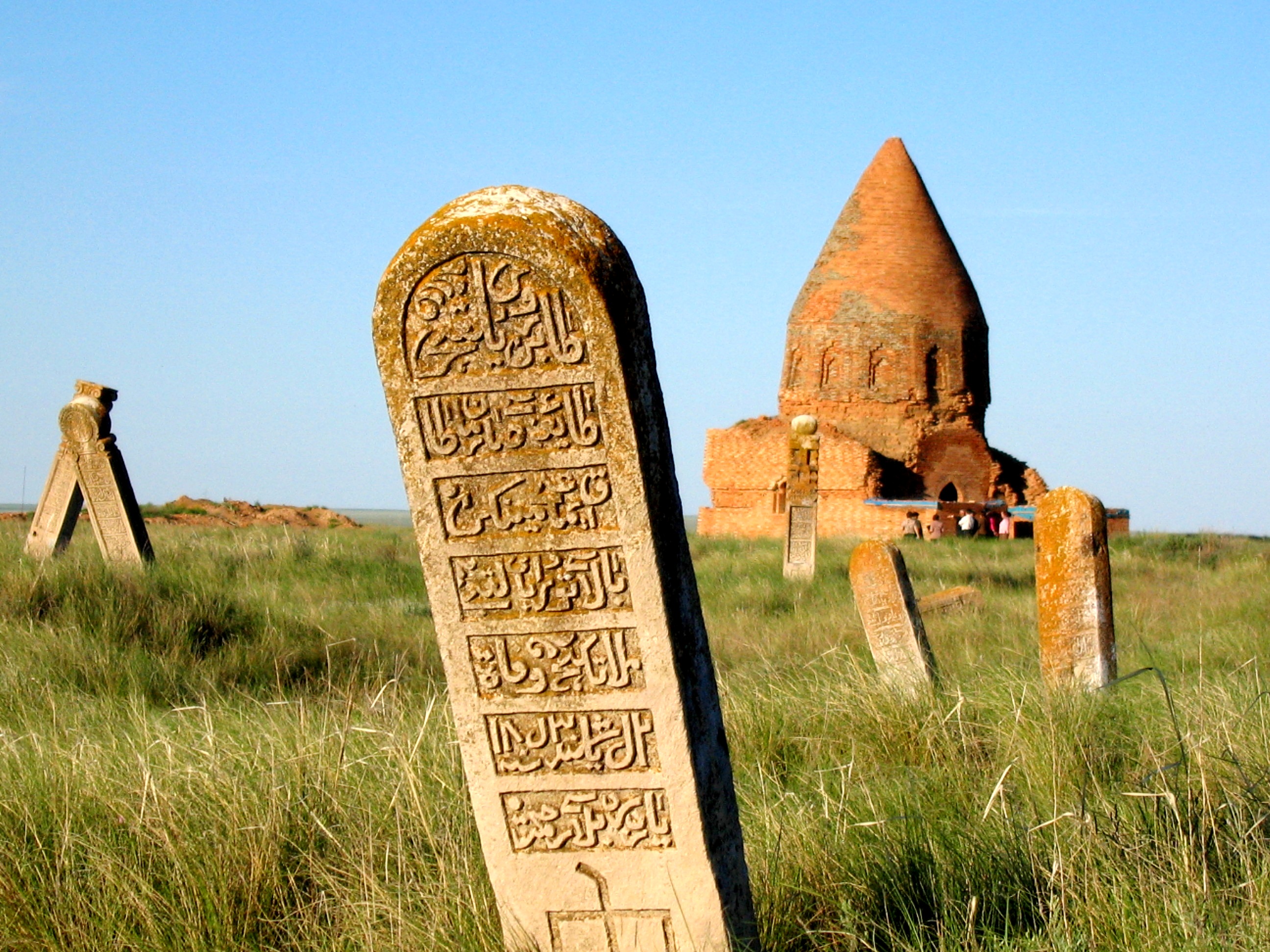
Examples of traditional stone-carving art are of particular significance. Approximately 40 stone monuments were identified within the necropolis during archaeological investigations. Among them are vertically installed gravestones known as koktas and horizontal tombstones called samarkantas.
Some samarkantas gravestones display similarities to the memorial art traditions of the Southern Kyzylkum, Nuratau, and Syr Darya regions. They were carved from marble-like stone and decorated with geometric ornaments, representations of small columns, and epigraphic inscriptions. The necropolis also contains gravestones made from local limestone and sandstone, characteristic of the stoneworking traditions of Western Kazakhstan.
Most inscriptions on the gravestones date from the second half of the 19th century to the early 20th century. Written in Arabic script, they reflect features of the Kazakh language and the Central Asian Turkic literary tradition. The epitaphs record the names of the deceased, their tribal affiliations, ages, and years of death. These inscriptions provide valuable evidence for studying the historical and ethnographic composition of the population buried in the necropolis.
Archaeological excavations have shown that most burials followed Islamic funerary traditions. The deceased were generally placed on their backs, with their faces oriented towards the qibla, the direction of prayer in Islam. Remains of wooden, reed, and brick coverings have been preserved in some graves.
Structure No. 92, identified by researchers as the burial place of Abulkhair Khan, is situated in the northern section of the necropolis. The remains of ancient funerary structures in this area became an important source of material for archaeological, anthropological, and genetic investigations.
The modern memorial complex consists of a new mausoleum and a monumental memorial structure erected in 2015. The mausoleum features a domed architectural form, while the monument is distinguished by its tall, upward-reaching vertical composition. The surrounding grounds have been landscaped and equipped with visitor areas and pedestrian pathways.
The present-day mausoleum is not the surviving original structure from the 18th century. It is a memorial monument constructed much later to commemorate Abulkhair Khan and mark his burial place.
The historical value of Khan Molasy is not limited to its individual monuments. The graves, remains of mausoleums, stone tombstones, epigraphic inscriptions, and surrounding natural landscape together form an integrated historical and cultural complex that developed over several centuries.
Did You Know?
There was a proposal to relocate Abulkhair Khan's remains. In the mid-18th century, the Orenburg administration cited a shortage of building materials near the burial site and suggested transferring the Khan's remains to a location along the Emba or Ural rivers. However, his sons rejected the proposal.
The original mausoleum was built by the Khan's descendants. Following several years of petitions and negotiations initiated by Nuraly Khan, an adobe-brick mausoleum was erected over Abulkhair's grave. Documentary evidence concerning its construction survives from 1752.
For many years, a solitary tree served as the main landmark of the Khan's grave. Local residents called it "Khannyn Taly," or "the Khan's Tree." It was regarded as an important sacred symbol associated with pilgrimage traditions. After the tree disappeared, locating the exact burial site became considerably more difficult.
Abulkhair Khan's grave was not identified immediately. During investigations conducted between 1998 and 2001, Structure No. 3 was considered the most likely burial place. Later, comprehensive interdisciplinary research linked the Khan's burial to Structure No. 92 in the northern part of the necropolis.
Khan Molasy is a large necropolis containing nearly a thousand burial monuments. Scientific investigations in 2001 recorded 942 burial features. Researchers believe that the original number of burials may have been even greater, as some graves deteriorated or became indistinguishable on the surface over time.
Interesting Facts
One of the most unusual aspects of Khan Molasy's history concerns a tree that served as an important historical landmark for several generations. The tree growing near Abulkhair Khan's grave was considered sacred by local residents. Pilgrims tied pieces of cloth to its branches as a sign of respect for the ruler's memory. Some historical accounts mention that the tree was repeatedly damaged by lightning but continued to produce new shoots.
Traditions associated with this tree were recorded in the works of travellers and researchers of the 18th and 19th centuries. The writings of N. Rychkov, D. Eristov, and I. Kraft provide differing descriptions of the Khan's grave and the rituals associated with it. By comparing these accounts, researchers were able to trace changes in the mausoleum's appearance and identify the landmarks historically used to determine its location.
Another interesting question concerns the original architectural appearance of the mausoleum. N. Rychkov described a rectangular structure made of adobe bricks, while D. Eristov mentioned a mausoleum with a dome-shaped upper section. Such differences may reflect changes in the building's appearance over time or variations in how the authors obtained their information. Consequently, researchers compare these historical accounts when studying the architecture of the original mausoleum.
The gravestones of the necropolis also preserve distinctive features of earlier periods. Some stone monuments closely resemble the artistic and technical traditions of stone carving practised in distant areas of the Southern Kyzylkum and Nuratau regions. Their ornaments and inscriptions provide information not only about the individuals buried there but also about the cultural connections of that period. Khan Molasy therefore offers valuable opportunities to study interactions between the cultural traditions of Western Kazakhstan and the Syr Darya region.
The history of the search for Abulkhair Khan's burial place is equally remarkable. Written accounts from the 18th century, historical records of the 19th century, recollections of local residents preserved in the 20th century, and modern scientific methods were brought together to address a single research question. It was the comprehensive comparison of evidence accumulated over several centuries that ultimately made it possible to identify the historical figure's burial place.
Why Is This Monument Important?
Khan Molasy is an important historical monument that brings together the political history of 18th-century Kazakhstan, traditional memorial culture, and the historical memory of the Kazakh people. Its primary significance lies in its association with the burial place of Abulkhair Khan, one of the most prominent statesmen and military commanders in Kazakh history.
The necropolis reflects the traditions of honouring historical figures in Kazakh society. The construction of a mausoleum over the Khan's grave, the emergence of additional burials around it, and the continuation of pilgrimage rituals across several generations demonstrate the site's considerable social and spiritual importance.
The monument also holds exceptional archaeological value. Hundreds of burial features, remains of adobe-brick mausoleums, stone enclosures, gravestones, and epigraphic inscriptions provide important scientific evidence about the burial traditions, architecture, and ethnocultural connections of the Kazakh population of the Northern Aral Sea region during the 18th–20th centuries.
Khan Molasy is also significant as an example of the effectiveness of historical and archaeological research. The investigation of Abulkhair Khan's burial place combined written documents, oral accounts, archaeological evidence, and anthropological and genetic studies. This work became an important example of the interdisciplinary study of historical figures and memorial monuments in Kazakhstan.
Today, Khan Molasy, encompassing both a historic necropolis and a modern memorial complex, contributes to preserving national historical memory, promoting knowledge of Kazakh statehood, and passing cultural heritage on to future generations. Its significance derives not only from its association with Abulkhair Khan but also from the integrity of the historical and cultural landscape that developed over several centuries.
Sources
Ажигали С. Е. Архитектура кочевников – феномен истории и культуры Евразии (памятники Арало-Каспийского региона). Алматы: НИЦ «Ғылым», 2002. 654 с. Pages consulted: 212–213, 342, 544–550.
История и культура Арало-Каспия: сборник статей. Вып. 1 / Под общ. ред. С. Ажигали. Алматы: Құс жолы, 2001. 228 с. Page consulted: 165.
Бекназаров Р. А. Казахи Северного Приаралья в XIX – начале XX вв. (историко-этнографическое исследование): монография. Алматы: Арыс, 2022. 472 с. Pages consulted: 343–349.
Әжіғали С. Е. Хан моласы, мемориалдық кешен // Ақтөбе облысының киелі географиясы. Табиғат, археология, сәулет және этнография нысандарының тізілімі. Алматы: Ә. Х. Марғұлан атындағы Археология институты, 2021. Pp. 460–465.
Ерофеева И. В. Хан моласы, мемориалдық кешен // Ақтөбе облысының киелі географиясы. Табиғат, археология, сәулет және этнография нысандарының тізілімі. Алматы: Ә. Х. Марғұлан атындағы Археология институты, 2021. Pp. 465–471.
Ажигали С. Е. Хан моласы қорымы, мемориалдық кешені // Archaeology.kz.
Photo gallery
Location on the map
Related sites
 National significance
Abat-Baytaq Necropolis, Memorial Museum Complex of Folk Architecture and Stone-Carving Art
Kobda district, 12 km southwest of Taldysai village
 National significance
Karasakal Necropolis: Mausoleum, Saganatam, Qulpytas, and Small Architectural Forms
Baiganin district, 60 kilometres southwest of Zharkamys village
 National significance
Daumshar Necropolis: Mausoleums, Saganatams, Qulpytases, and Small Architectural Forms
Baiganin district, 40 kilometres southwest of Zharkamys village